




You use Amazon to buy groceries, watch TV shows, and get packages delivered the same afternoon.
But here is what most people never think about: the part of Amazon you actually see, the store, is its least profitable piece.
In 2025, Amazon generated $716.9 billion in total revenue. Yet the online retail segment, the one that ships you shampoo and headphones, ran at just a 2.4% operating margin. Most of Amazon’s real money comes from places you rarely notice.
This breakdown explains the full Amazon business model, every major revenue stream, why the flywheel strategy works, and what makes this one of the most studied companies in modern business history.
What is Amazon’s Business Model?
Amazon operates what experts call a multi-sided platform business model.
It does not just sell products to customers. It serves multiple groups at the same time: shoppers, independent sellers, businesses running apps on the cloud, advertisers, content creators, and enterprise IT teams. Each group gets value. Each group pays in some form.
The result is an ecosystem where each piece feeds every other piece.
Amazon reports its financials in three main segments:
- North America (retail and services in the US and Canada)
- International (retail and services everywhere else)
- Amazon Web Services (AWS) (cloud computing globally)
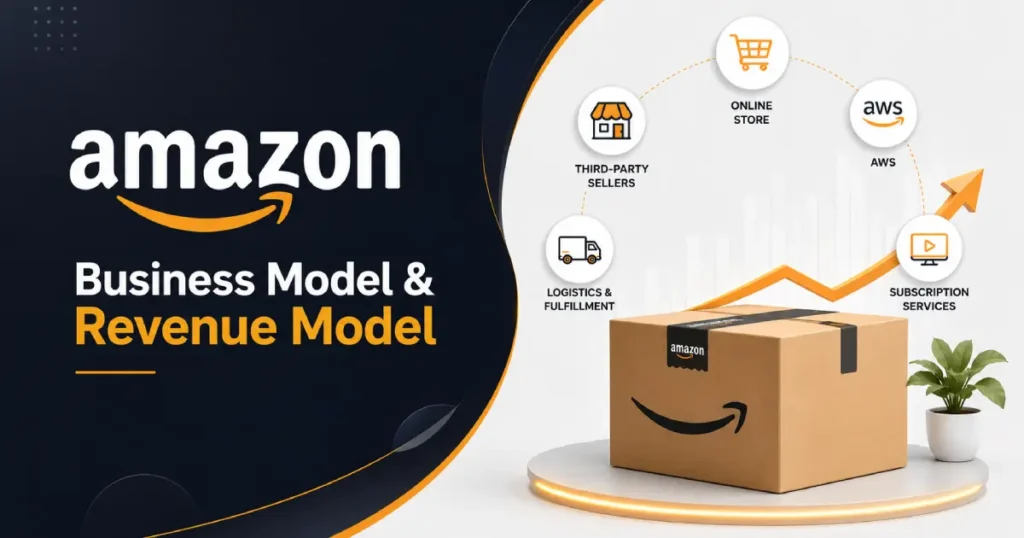
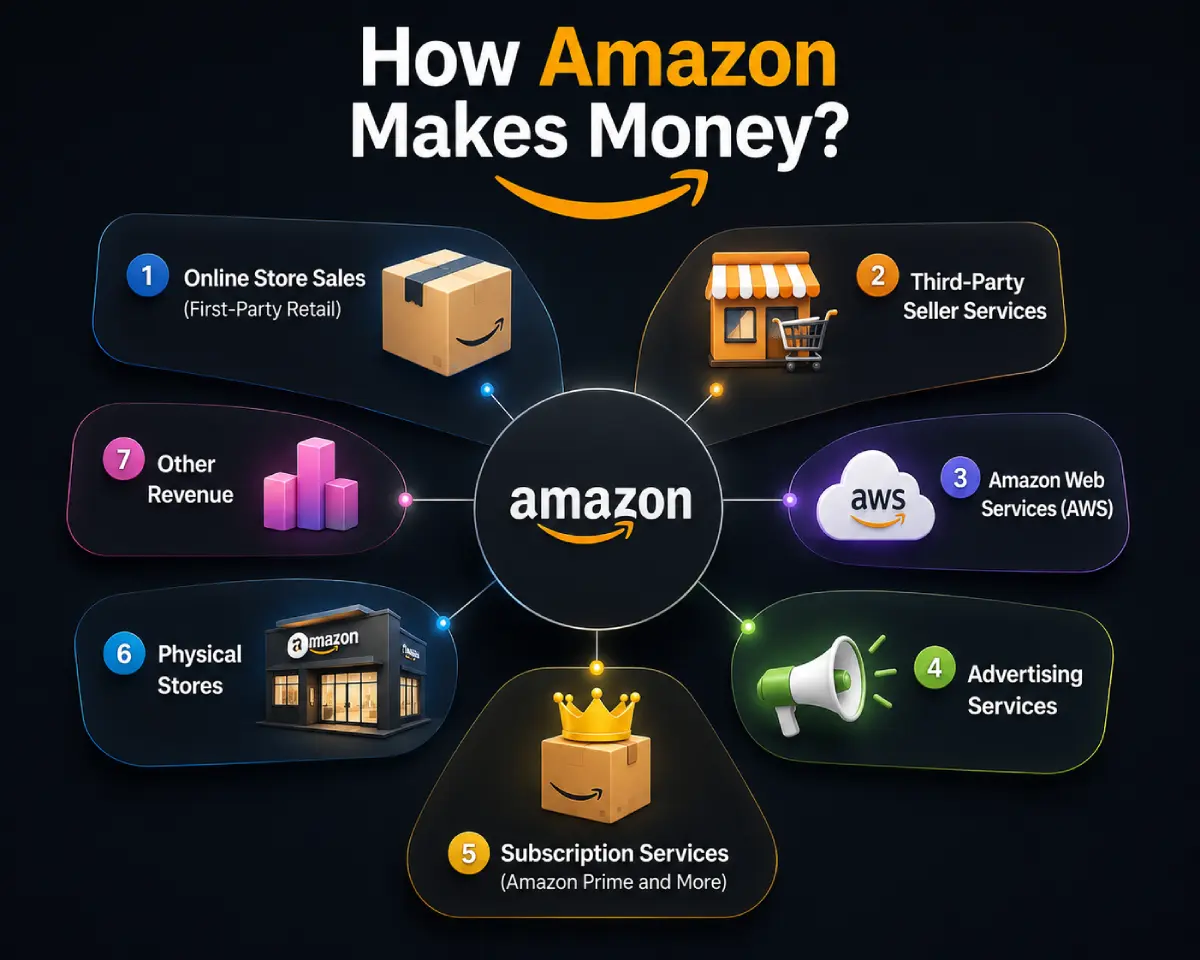
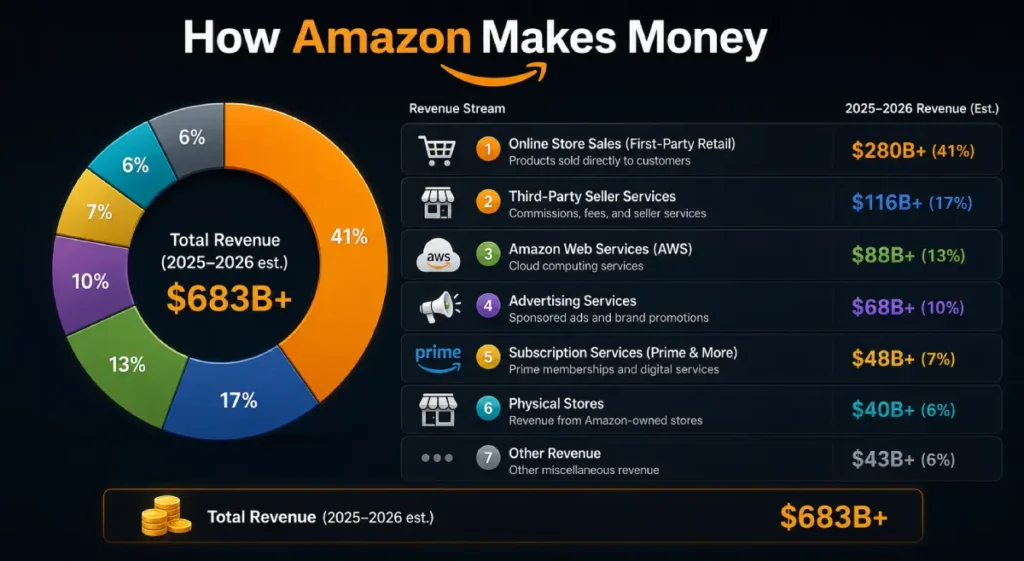
Within those, it breaks down seven specific revenue streams. Understanding each one shows exactly how Amazon makes money at scale.
Amazon’s Revenue Streams Explained
1. Online Store Sales (First-Party Retail)
This is the Amazon most people know. The company buys products wholesale, stocks them in fulfillment centers, and sells them directly to you.
In 2025, this segment brought in $269.3 billion, which is about 37.6% of total revenue.
Despite that enormous number, the margins here are thin. Amazon takes on full inventory risk, pays warehousing and shipping costs, and competes on price constantly. This division runs at under 5% operating margin.
So why does Amazon keep doing it?
Because first-party retail drives traffic, trains the recommendation algorithm, builds purchase data, and keeps customers loyal to the platform. It is an engine that powers everything else, not a profit center on its own.
2. Third-Party Seller Services
This is where it gets interesting.
More than 62% of all physical units sold on Amazon come from independent third-party sellers, not from Amazon itself. These sellers pay Amazon referral fees (typically 6% to 15% depending on category), plus fees for Fulfillment by Amazon (FBA) if they want Amazon to handle storage, packing, and shipping.
In 2025, third-party seller services generated $172.2 billion, which is 24% of total revenue.
This is Amazon’s most capital-efficient stream. It earns fees without owning a single unit of inventory. The more sellers join, the wider the selection. The wider the selection, the more customers come. The more customers come, the more sellers want in.
That cycle has a name. It is called the Amazon Flywheel.
3. Amazon Web Services (AWS)
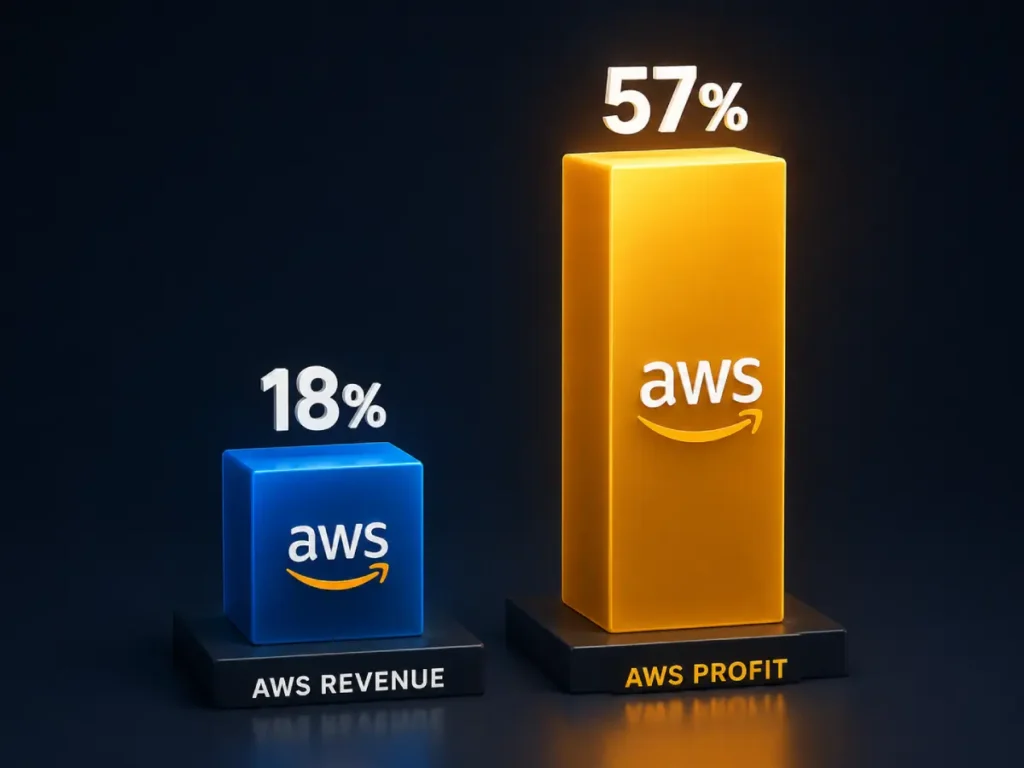
AWS is the engine behind Amazon’s profitability.
Launched in 2006 to solve Amazon’s own internal infrastructure problems, AWS became the world’s largest cloud platform. It now powers Netflix, NASA, Airbnb, the CIA, and millions of startups worldwide.
In 2025, AWS generated $128.7 billion in revenue with $45.6 billion in operating income. That is 57% of Amazon’s total operating profit coming from just 18% of its total revenue.
Read that again. AWS is 18% of Amazon’s revenue but produces 57% of its profit.
Customers pay for compute power, data storage, machine learning tools, databases, and networking on a pay-as-you-go basis. Enterprise contracts add predictable recurring revenue on top.
AWS grew 20% year-over-year in 2025, with Q4 2025 accelerating to 24% growth driven by demand for generative AI infrastructure.
4. Advertising Services
Most people do not think of Amazon as an advertising company. They should.
Amazon’s ad business pulled in $68.6 billion in 2025, making it larger than Amazon Prime revenue and one of the top three digital ad platforms in the United States alongside Google and Meta.
How does it work? Sellers pay for sponsored product placements that appear in search results and product pages. Brands pay for display and video ads across Amazon’s entire ecosystem, including Prime Video, Fire TV, and Twitch.
The power of Amazon’s ad business comes from one thing: purchase intent data. When someone searches on Google, they might be researching. When someone searches on Amazon, they are ready to buy. That signal is worth premium ad rates.
This business is asset-light. Amazon already built the platform. Ads are almost pure margin stacked on top.
5. Subscription Services (Amazon Prime and More)
Amazon Prime is one of the most successful subscription products in history.
As of 2025, Prime has over 240 million global members. In the United States, it is in roughly two-thirds of all households. The annual fee in the US sits at $139 per year (or $14.99 per month).
What does the data show about Prime members? The average US Prime member spends approximately $1,400 per year on Amazon. A non-Prime customer spends around $600.
That spending gap is the entire logic of Prime. Amazon bundles fast shipping, Prime Video, Music, exclusive deals, and more into one fee. Customers who join the bundle buy more. They stay longer. They become loyal to the ecosystem.
Beyond Prime, subscriptions include Kindle Unlimited, Audible, and Amazon Music. Together, subscription services totaled $49.6 billion in 2025.
6. Physical Stores
Amazon also operates bricks-and-mortar retail.
This includes Whole Foods Market (acquired for $13.7 billion in 2017), Amazon Fresh grocery stores, and Amazon Go cashierless convenience stores.
In 2025, physical stores generated $22.6 billion, about 3.1% of total revenue.
The strategic logic here is not purely financial. Whole Foods gave Amazon a foothold in the $1 trillion US grocery market. Amazon Go stores test cashierless technology that Amazon licenses to other retailers. Physical retail is partly a laboratory for future tech bets.
7. Other Revenue
This catch-all category includes items like revenue from Amazon’s hardware devices, including Kindle, Echo, Fire tablets, and Ring security systems, along with revenue from Amazon Health (including One Medical and Amazon Pharmacy).
In 2025, this segment contributed $5.9 billion.
Hardware devices are not sold to make hardware profit. They are sold to deepen customer lock-in. Every Echo speaker sold is a new entry point into the Amazon ecosystem that generates more shopping, more Prime usage, and more ad impressions.
The Amazon Flywheel: Why the Whole Model Works
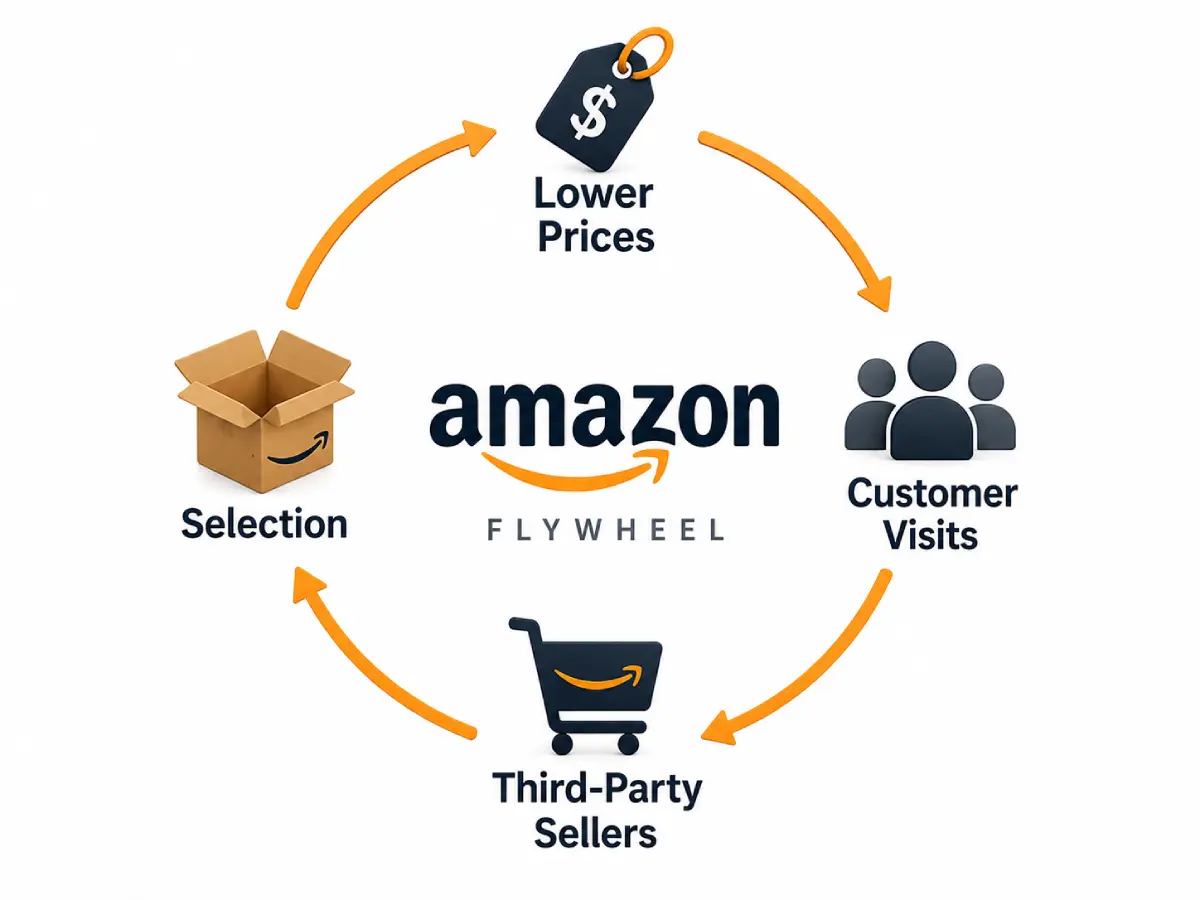
Every piece above connects to one central concept: the Amazon Flywheel.
Jeff Bezos sketched it out on a napkin in the early 2000s. The logic goes like this:
Lower prices attract more customers. More customers attract more third-party sellers who want access to that audience. More sellers mean greater product selection. Greater selection improves the customer experience. A better experience lets Amazon grow and use scale to lower prices further.
This loop feeds itself. And as the loop spins, fixed costs get spread across more revenue, which improves margins, which fund new investments into logistics, technology, and new product categories.
AWS profits fund logistics innovation. Advertising profits fund free shipping subsidies. Prime membership fees fund content creation on Prime Video. Every piece is connected.
Amazon’s Cost Structure
Understanding how Amazon makes money also means understanding what it spends.
In 2025, Amazon’s biggest costs were:
- Cost of sales: $356.4 billion (inventory, shipping, content)
- Fulfillment: $109.1 billion (warehouses, delivery, returns)
- Technology and infrastructure: $91.0 billion (AWS servers, AI R&D, software)
- Sales and marketing: $37.7 billion
The company’s overall operating margin improved to 11.2% in 2025, up from around 6% in 2022. AWS and advertising, both high-margin businesses, are lifting the overall profitability as their share of revenue grows.
Amazon plans to invest up to $200 billion in capital expenditures in 2026, focused on AI infrastructure, data centers, robotics, and satellite internet.
What Is Amazon Betting on Next?
Generative AI and Cloud
AWS is the infrastructure backbone for the AI boom. Amazon is investing heavily in custom AI chips (Trainium for training, Inferentia for inference) to offer better price-performance than Nvidia GPUs. AWS Bedrock allows businesses to build and deploy AI applications on Amazon’s platform.
AWS growth re-accelerated to 24% in Q4 2025 specifically because enterprises are shifting workloads to AI-enabled cloud infrastructure.
Amazon Leo (Satellite Internet)
Formerly called Project Kuiper, Amazon Leo is targeting a mid-2026 commercial launch. With 241 satellites already in orbit and a planned 3,236-satellite network, this project targets broadband access in rural and remote areas.
The dual purpose: a new revenue stream from internet subscriptions and an expanded market for AWS edge-to-cloud services in regions currently underserved by broadband.
Healthcare
Amazon has been quietly building in healthcare for years. One Medical (acquired for $3.9 billion) gives Amazon a primary care network. Amazon Pharmacy offers prescription delivery. Amazon Health services could become a meaningful revenue driver by the late 2020s.
Amazon’s Business Model in 2025 by the Numbers
| Revenue Stream | 2025 Revenue | % of Total |
| Online Stores | $269.3B | 37.6% |
| Third-Party Seller Services | $172.2B | 24.0% |
| AWS | $128.7B | 18.0% |
| Advertising | $68.6B | 9.6% |
| Subscription Services | $49.6B | 6.9% |
| Physical Stores | $22.6B | 3.1% |
| Other | $5.9B | 0.8% |
| Total | $716.9B | 100% |
Amazon’s net income in 2025 reached $77.7 billion, more than double 2023’s figure of $30.4 billion.
What Business Owners and Entrepreneurs Can Learn from Amazon
Amazon’s story is not just about scale. The principles behind the model apply to businesses of any size.
Build a flywheel, not just a product. The most durable businesses create loops where each action reinforces the next. More customers improve the product. A better product attracts more customers. Ask what your flywheel looks like.
Use a low-margin entry point to capture high-margin relationships. Retail is Amazon’s loss leader. What is yours? Sometimes giving value cheaply upfront creates loyalty that generates far more profitable revenue downstream.
Layer revenue streams over time. Amazon did not launch with AWS and advertising. It started with books. Each new revenue stream was added once the core was stable. Build in layers.
Own infrastructure and rent it out. Amazon built fulfillment and cloud for itself, then discovered others would pay for access. If your business has infrastructure others need, that is a business model waiting to happen.
Final Thoughts
Amazon is not an e-commerce company that also does cloud. It is a technology and infrastructure company that uses retail as the front door.
The store brings you in. AWS, advertising, Prime, and seller services make the money. The flywheel keeps everything spinning.
In 2025, Amazon generated nearly $717 billion in revenue and $77.7 billion in net income. It delivers over 8 billion items same-day or next-day. It powers a significant share of the modern internet through AWS.
Understanding how Amazon’s business model works is understanding how the next generation of platform businesses gets built.
If you found this breakdown useful, share it with someone building a business. And if you want more deep-dives into business models like this one, check out our breakdown of how Zomato makes money and how Zepto built its quick commerce model.