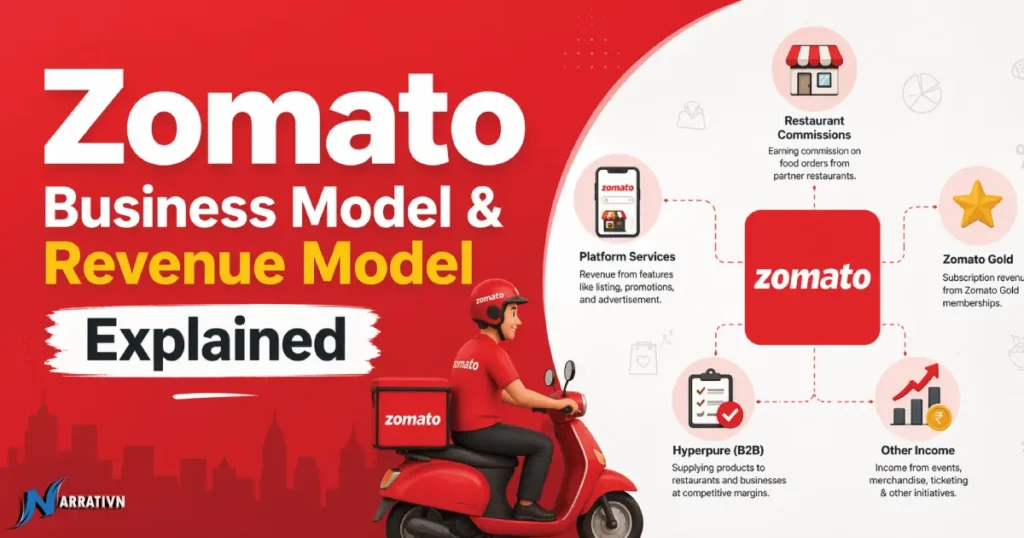
Zomato is not just a food delivery app. It is the consumer-facing brand of Eternal Limited, a multi-vertical platform that also runs Blinkit, Hyperpure, and District — four distinct businesses that together reported ₹20,243 crore in operating revenue in FY25. (Source: Eternal Limited Annual Report, FY25)
Zomato’s business model works as a three-sided marketplace connecting customers, restaurants, and delivery partners — and makes money from commissions, advertising, subscriptions, and B2B supply. In FY25, revenue grew 67% year-on-year, and the company posted a profit after tax of ₹527 crore. If you have ever wondered how an app that charges you ₹40 in delivery fees can be worth billions — this breakdown answers exactly that.
What Is Zomato?
Zomato is an Indian food delivery and restaurant discovery platform founded in 2008 by Deepinder Goyal and Pankaj Chaddah. It connects customers to restaurants through a digital marketplace and fulfils orders through a network of delivery partners.
Today, the Zomato app is one part of a larger company. Since March 2025, the parent entity is officially named Eternal Limited — a holding company that oversees four distinct businesses: Zomato (food delivery), Blinkit (quick commerce), Hyperpure (B2B food supply), and District (events and dining out).
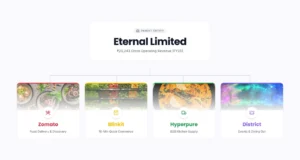
We think this distinction is essential before we go any deeper. Most blogs explain the Zomato business model as if it is still just a food delivery app. It has not been that for years. Understanding the full Eternal structure is the only way to understand how Zomato makes money at scale in 2025.
From Foodiebay to Eternal: A 17-Year Business Pivot
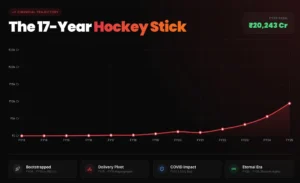
Zomato’s origin story is deceptively simple. In 2008, Deepinder Goyal noticed his colleagues spending too long browsing paper menus at their workplace in Delhi. He scanned a few menus, put them online, and called the site Foodiebay.
Within nine months, it was Delhi’s largest restaurant directory. By 2010, it was renamed Zomato to avoid a naming conflict with eBay. By 2012, it had expanded internationally across the UK, South Africa, New Zealand, Brazil, and more.
The major strategic inflections came in waves:
- 2015 — Entered food delivery. Shifted from a pure discovery platform to a transaction platform.
- 2017 — Launched Zomato Gold, a subscription product for complimentary dining benefits.
- 2018 — Launched Hyperpure, a B2B supply chain connecting farmers to restaurant kitchens.
- 2021 — IPO on NSE and BSE, raising $1.3 billion. First public listing for a major Indian food-tech company.
- 2022 — Acquired Blinkit (formerly Grofers) for $568 million, entering quick commerce.
- 2024 — Acquired Paytm’s entertainment ticketing business for ₹2,014 crore, launching District.
- 2025 — Rebranded the parent entity from Zomato Limited to Eternal Limited.
What is easy to miss in this timeline is that every single pivot — Gold, Hyperpure, Blinkit, District — was a deliberate move to reduce the company’s dependence on food delivery commissions alone. By FY25, food delivery contributed roughly 35% of quarterly revenue, with Blinkit and Hyperpure each growing at triple-digit rates year-on-year. (Source: Eternal Limited Q4 FY25 Earnings)
What Is Zomato’s Business Model?
Zomato’s business model is a multi-vertical platform that earns from every participant in its ecosystem — customers, restaurants, delivery partners, and FMCG brands.
At the core, it runs a three-sided marketplace:
- Customers discover restaurants, place orders, and pay delivery fees and platform charges.
- Restaurants pay commissions on each order, and separately pay for advertising visibility on the app.
- Delivery partners earn per delivery; Zomato earns by optimising delivery efficiency at scale.
On top of this delivery marketplace, Eternal operates three additional verticals, each with its own revenue model:
| Vertical | What It Does | Primary Revenue Source |
| Zomato | Food delivery + restaurant discovery | Commissions + advertising + subscriptions |
| Blinkit | Quick commerce — groceries in 10 minutes | Product margins + delivery fees + ad revenue |
| Hyperpure | B2B fresh ingredients supply to restaurants | Product margins on bulk supply |
| District | Event ticketing + dining-out experiences | Ticket sales + restaurant booking fees |
This four-vertical architecture is what separates Eternal from pure-play competitors like Swiggy. We believe the long-term competitive advantage here is cross-sell: a user who orders dinner on Zomato can be nudged to buy groceries on Blinkit, get ingredients from Hyperpure (if they run a restaurant), and book a table or event on District — all within Eternal’s ecosystem.
How Does Zomato Make Money? All Revenue Streams Explained
Zomato’s revenue model has six major streams across its verticals. None of them are accidental — each maps to a specific participant in the ecosystem.
1. Restaurant Commissions (Core Revenue Stream)
Every time a customer places a food order on Zomato, the restaurant pays a commission on the order value. Zomato’s take rate typically falls in the 20–25% range, with variation based on city tier, restaurant category, and deal terms. (Source: Miracuves / Eternal Filings, 2025)
Here is a quick illustration of how this works in practice: if a customer places a ₹1,000 order at a Mumbai restaurant, Zomato earns approximately ₹200–₹250 as its commission on that order. At 853 million food delivery orders in FY25, with an average order value of ₹453 — the revenue scale is significant. (Source: Eternal Limited FY25 Annual Report)
Commission revenue is still the backbone of Zomato’s food delivery business, even as newer verticals grow faster. In Q4 FY24, the food ordering and delivery segment grew 48% year-on-year to ₹1,739 crore. (Source: Geojit Financial Services Research, 2025)
2. Customer-Side Fees (Platform + Delivery Charges)
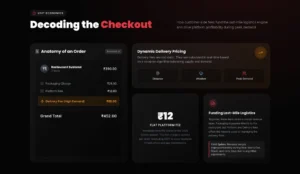
On every order, customers pay:
- Delivery fee — varies by distance, demand conditions, and time of day. Surge pricing applies during peak hours and poor weather.
- Platform fee — a flat per-order charge. Ahead of the 2025 festive season, Zomato increased its platform fee from ₹10 to ₹12 per order (excluding GST). (Source: Times of India, 2025)
- Packaging charges — added by restaurants, passed through the platform.
Together, these fees contribute a meaningful layer of per-order revenue that helps cover last-mile logistics costs. Dynamic pricing during high-demand periods — Diwali, New Year’s Eve, rainy days — generates disproportionately higher fee revenue.
3. Advertising Revenue
Zomato operates one of India’s most targeted restaurant advertising platforms. Restaurants pay to:
- Appear at the top of search results (sponsored listings)
- Run banner ads on category and homepage surfaces
- Run time-based and location-based promotions targeting high-intent users
This functions identically to Google Ads — but the advantage Zomato offers is that users on the app are already in food-ordering mode, which means ad-to-order conversion is far higher than generic display advertising.
According to Eternal’s FY25 filings, advertising is one of Zomato’s fastest-growing revenue lines across both the food delivery app and Blinkit. We see this as Zomato building toward the same retail media flywheel that Amazon has mastered globally — where the advertising segment eventually becomes as profitable as, or more profitable than, the core marketplace. (Source: Exchange4media / Eternal Filings, 2025)
4. Subscription Revenue — Zomato Gold
Zomato Gold is the company’s paid membership programme. Members pay a recurring fee (monthly or annual) and receive:
- Free delivery on qualifying orders
- Dining discounts at partner restaurants
- Priority order processing
- Exclusive offers and early access
Subscription programmes generate three things Zomato values highly: upfront recurring revenue, higher order frequency from members, and reduced customer acquisition cost over the member’s lifetime. Competitors like Swiggy One and Amazon Prime have proven that once a user pays for a subscription, their switching cost increases dramatically. We see Zomato Gold following the same compounding logic.
5. Hyperpure — B2B Supply Chain Revenue
Launched in 2018, Hyperpure is Zomato’s B2B arm that supplies fresh ingredients — vegetables, fruits, dairy, grains, meat — directly from farms and producers to restaurant kitchens and Blinkit’s dark stores.
Hyperpure’s revenue doubled year-on-year for multiple consecutive years, and in Q4 FY25 its revenue grew 93% year-on-year. (Source: Miracuves / Eternal Filings, 2025) It serves over 30,000 restaurants across 10 Indian cities.
The strategic value of Hyperpure extends beyond revenue. According to Eternal’s research, over 70% of top-performing restaurants on Zomato already use Hyperpure partially. (Source: Goodluck Capital FY25 Research Report) This creates a loyalty and data loop — Hyperpure’s visibility into what restaurants order and how much they use gives Eternal a procurement intelligence advantage no pure-play delivery platform can replicate.
6. District — Events and Dining-Out Revenue
District, acquired from Paytm in March 2024 for ₹2,014 crore, is Eternal’s bet on the “going out” experience. It currently offers:
- Ticketing for cricket matches, live events, and concerts
- Table reservations at partner restaurants
- Dining-out deals and curated experiences
District is still the smallest of Eternal’s four verticals by revenue, but its strategic logic is clear: urban Indians who order food at home also go out, attend events, and book experiences. Owning that surface area means Eternal captures more of the consumer’s discretionary spend — not just mealtimes.
How Does Zomato’s Food Delivery Commission Actually Work?
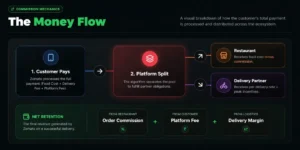
Zomato’s commission model is one of the most discussed — and most misunderstood — aspects of its business. Here is how it actually works, step by step.
- A customer places an order through the Zomato app. The app shows restaurants, menu items, and estimated delivery time.
- Zomato processes the full payment from the customer — including food cost, delivery fee, and platform fee.
- After the order is fulfilled, Zomato remits the food cost portion to the restaurant, minus its commission.
- Separately, Zomato pays the delivery partner a per-delivery rate (plus incentives during peak hours).
- Zomato retains: the commission on the order value + the platform fee + a portion of the delivery fee.
The commission typically ranges between 20–25% of the order value. (Source: Eternal Filings / Industry Commentary, 2025) Newer entrants like Rapido have positioned themselves at roughly half of Zomato’s commission rate to attract restaurant partners — which is why Zomato’s advertising and subscription products have become increasingly important as commission pressure builds from below.
What is worth noting: when you see “free delivery” on an order, it does not mean Zomato is absorbing the cost out of goodwill. The delivery cost is either covered by the restaurant as a promotional expense, subsidised by Zomato temporarily as a customer acquisition tool, or offset by the user’s Zomato Gold membership.
What Is Hyperpure — and Why It Matters More Than You Think
Most people know Zomato as the red app on their phones. Very few know that Zomato runs one of the most interesting B2B food supply businesses in India through Hyperpure — and we think this vertical is significantly underappreciated.
Hyperpure is Eternal’s direct farm-to-kitchen supply chain. It sources produce, dairy, and staples from farmers and certified suppliers, then delivers them to restaurant kitchens across 10 Indian cities. Unlike traditional food distributors that work through middlemen, Hyperpure has invested in traceability — pesticide-free produce, certified supply chains, and ESG-aligned sourcing. This appeals especially to premium chains and cloud kitchens that need clean, consistent ingredients.
The financial case is equally strong. Hyperpure’s revenue grew 93% year-on-year in Q4 FY25 — faster than any other Eternal vertical except Blinkit. (Source: Eternal Limited Q4 FY25 Earnings) Eternal is now integrating Hyperpure more deeply with Blinkit’s dark store supply chain, which creates economies of scale that improve margin for both verticals simultaneously.
For Zomato’s food delivery business, Hyperpure’s existence creates an asymmetric advantage: the restaurants most loyal to Zomato’s delivery platform are also the restaurants most likely to rely on Hyperpure for their kitchen supply. That combination of delivery demand and supply dependence makes it structurally difficult for a restaurant to walk away from Eternal’s ecosystem.
What Is District — Zomato’s Bet on Live Experiences?
District is Eternal’s newest and least-discussed vertical. It entered the portfolio in August 2024 when Eternal completed the acquisition of Paytm’s entertainment and ticketing business for ₹2,014 crore.
District currently lets users book tickets for cricket matches, live events, and concerts — with a restaurant table-booking and dining-out layer. The long-term vision is to become the default platform for everything an urban Indian does outside their home — experiences, events, and dining.
Critics of this acquisition argued the price was too high and the category too competitive (BookMyShow dominates Indian event ticketing with a strong moat). Supporters counter that the synergy with Zomato’s existing urban food-ordering user base is real — someone booking a dinner reservation through District is a more engaged user than someone who only uses the food delivery app.
District is currently a small contribution to Eternal’s total revenue. But we see its strategic value as user engagement depth: a platform that touches a user’s lunch, their groceries, their restaurant booking, and their weekend concert tickets is a platform that is extremely hard to delete.
Zomato vs. Swiggy: How the Business Models Differ
India’s food delivery market is dominated by two players, and the structural differences between them are more significant than most analyses capture.
| Feature | Zomato (Eternal) | Swiggy |
| Food Delivery Commission | 20–25% | Similar range |
| Quick Commerce | Blinkit — market leader, 45% share | Swiggy Instamart — 27% share |
| B2B Supply | Hyperpure (farms to restaurants) | No equivalent |
| Events/Ticketing | District | No equivalent |
| Subscription | Zomato Gold | Swiggy One |
| IPO Status | Listed (Eternal on NSE/BSE since 2021) | Listed (IPO in Nov 2024) |
| FY25 Revenue | ₹20,243 crore (Eternal group) | ~₹15,000 crore (estimated) |
(Source: Eternal Limited FY25 Annual Report; Swiggy IPO Prospectus; Industry Estimates)
The most structurally significant gap is not quick commerce or food delivery — it is the absence of a Hyperpure equivalent at Swiggy. By controlling the ingredient supply chain, Eternal has a loyalty mechanism that goes beyond a delivery app. Restaurant operators who depend on Hyperpure for their ingredients are less likely to de-list from Zomato when commission pressure rises. That is a competitive moat built in the supply chain, not on a customer-facing screen.
Case Study: How Zomato Turned Its Food Delivery Network Into an Ad Platform
This is one of the most underanalysed parts of Zomato’s business, and we think it represents the most important revenue growth story in the company’s near-term future.
Between 2021 and 2024, Zomato built out a restaurant advertising product that functions as the food delivery equivalent of Amazon Advertising. Restaurants that paid for sponsored placements on the app started appearing at the top of search results — and the conversion rates were exceptional, because users browsing Zomato were already in active purchase mode.
By FY25, advertising had become one of the fastest-growing revenue lines in both the Zomato food delivery app and Blinkit. Major FMCG brands — HUL, ITC, Nestlé — were paying for placement not just for brand visibility, but because Blinkit and Zomato’s hyperlocal intent data made them far more effective ad channels than traditional media for new product launches.
Amazon’s advertising segment now earns more operating profit than its AWS cloud business — a fact that surprises most people who think of Amazon as a retailer or cloud company. We think Zomato is following an identical trajectory: as order volume scales past 1 billion annually and daily active users deepen, the advertising platform becomes increasingly high-margin and increasingly central to Eternal’s overall profitability. The capital investment in logistics is already sunk. The advertising revenue rides on top of that infrastructure at near-zero marginal cost.
What Do the Financials Actually Say?
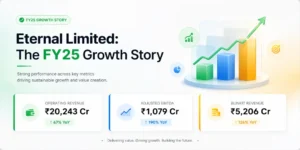
The numbers behind Zomato’s business model are as compelling as the strategy.
Eternal Limited — Key Financial Metrics:
| Metric | FY24 | FY25 | Growth |
| Operating Revenue | ₹12,114 crore | ₹20,243 crore | +67% YoY |
| Profit After Tax | ₹351 crore | ₹527 crore | +50% YoY |
| Adjusted EBITDA | ₹372 crore | ₹1,079 crore | +190% YoY |
| Blinkit Revenue | ₹2,301 crore | ₹5,206 crore | +126% YoY |
| Food Delivery Orders (FY25) | — | 853 million | — |
| Average Order Value (Food) | — | ₹453 | — |
(Source: Eternal Limited FY25 Annual Report; Axis Securities Research, 2025)
Q2 FY26 Snapshot:
Eternal reported consolidated revenue of ₹13,590 crore in Q2 FY26 — a 183% year-on-year increase — though much of this reflects the consolidation of Blinkit’s inventory-led model into reported revenue. Net profit came in at ₹65 crore for the quarter, with EBITDA margin at 1.76%, reflecting continued heavy investment in Blinkit’s dark store expansion. (Source: Business Upturn / Eternal Q2 FY26 Results)
The headline to understand here is this: Zomato’s food delivery business is profitable and stable. It generates consistent positive contribution margins and funds the expansion of newer, higher-growth verticals like Blinkit and District. Blinkit, in turn, is investing heavily in dark store infrastructure and is currently margin-negative at the EBITDA level — but it is following the identical playbook Blinkit used in Delhi-NCR, where it first achieved contribution positivity after reaching store density.
In Q1 FY26, Blinkit’s net order value surpassed the core food delivery business for the first time. (Source: Appsrhino / Eternal Q1 FY26 Filings) That is a historic inflection point in Eternal’s revenue composition — and it happened within three years of the Blinkit acquisition.
What Does Zomato’s Future Look Like?
We see four clear growth vectors shaping Eternal’s next phase.
- Blinkit’s March to 3,000 Dark Stores Blinkit targeted 2,000 dark stores by FY26 and 3,000 by March 2027. Each new dark store in a high-density geography improves the unit economics of the entire cluster — we covered this dynamic in detail in our Blinkit business model breakdown. As density increases in Bengaluru, Hyderabad, and Chennai the way it has in Delhi-NCR, we expect contribution margins to improve structurally.
- Hyperpure’s Expansion into Non-Restaurant Channels Eternal has publicly stated its intention to expand Hyperpure beyond restaurant clients into retail and dark store supply chains. This broadens the addressable market significantly. A B2B supply business that serves both Blinkit dark stores and restaurant kitchens creates procurement scale that competitors cannot match.
- Advertising Platform Maturity As daily order volume scales past 2 million across Zomato and Blinkit combined, the advertising platform becomes more valuable to FMCG brands — particularly for new product launches where immediate hyperlocal feedback is more valuable than traditional retail data. We expect advertising to become a 20%+ revenue contributor across the Eternal group within two fiscal years.
- District’s Long-Term Bet on Urban Experience Commerce Compared to Zepto’s pure quick-commerce model and Swiggy Instamart’s integrated delivery play, Eternal’s investment in District gives it a surface the others simply do not have. Event ticketing may be a small revenue line today, but the engagement data it generates — who is going out, what they spend on experiences, which neighbourhoods are active on weekend nights — is invaluable for targeting across the entire platform.
FAQ
What is Zomato’s primary source of revenue?
Zomato’s primary revenue comes from commissions charged to restaurants on food delivery orders. Restaurants typically pay 20–25% of each order’s value to Zomato. Across 853 million food delivery orders in FY25, this commission revenue remains the backbone of the food delivery business, even as advertising and subscription revenues grow faster. (Source: Eternal Limited FY25 Annual Report)
How does Zomato make money from customers?
Zomato charges customers a delivery fee per order, which varies based on distance and demand conditions. It also charges a platform fee — raised from ₹10 to ₹12 per order in 2025. Customers who subscribe to Zomato Gold pay a recurring fee for free delivery and dining benefits. Together, these customer-side charges supplement the commission revenue Zomato earns from restaurants.
Is Zomato profitable in 2025?
Yes. Eternal Limited (Zomato’s parent) posted a profit after tax of ₹527 crore in FY25, up 50% year-on-year. The core food delivery business is contribution-positive. Blinkit continues to invest heavily in dark store expansion, which compresses group EBITDA margins in the near term, but the food delivery segment funds this investment. (Source: Eternal Limited FY25 Annual Report)
What is the difference between Zomato and Eternal?
Zomato is the food delivery app and brand. Eternal Limited is the parent company that owns Zomato along with Blinkit (quick commerce), Hyperpure (B2B food supply), and District (events and dining out). The company changed its name from Zomato Limited to Eternal Limited in March 2025 to reflect its expanded multi-vertical business. (Source: Eternal Limited / Wikipedia)
How does Zomato Gold work?
Zomato Gold is a paid membership programme where subscribers pay a recurring fee for benefits including free delivery on qualifying orders, restaurant dining discounts, and priority service. It generates recurring revenue for Eternal and increases order frequency among members, since subscribers tend to order more to justify the subscription cost.
How is Zomato different from Swiggy?
Beyond food delivery, Zomato has a significant structural advantage: Blinkit holds 45% of India’s quick-commerce market versus Swiggy Instamart’s 27%. More importantly, Zomato operates Hyperpure, a B2B ingredient supply chain with no Swiggy equivalent, which creates a restaurant loyalty mechanism beyond the delivery platform. District, for events and dining out, is another vertical Swiggy does not operate. (Source: Eternal Limited FY25 Filings; Industry Reports)
What is Hyperpure and how does it make money?
Hyperpure is Eternal’s B2B supply chain that delivers fresh produce, dairy, and ingredients from farms directly to restaurant kitchens and dark stores. It earns revenue from the margin on these B2B product sales. In Q4 FY25, Hyperpure’s revenue grew 93% year-on-year, making it one of Eternal’s fastest-growing verticals. Over 30,000 restaurants across 10 Indian cities use the service. (Source: Eternal Limited Q4 FY25 Earnings)
What is the District app and how does it fit into Zomato’s model?
District is Eternal’s events and dining-out platform, acquired from Paytm in 2024 for ₹2,014 crore. It currently offers event ticketing for cricket, concerts, and live events, along with restaurant table reservations and dining deals. Strategically, District is Eternal’s bet on capturing urban Indians’ spend on going-out experiences — not just food delivery. It is currently the smallest of Eternal’s four verticals by revenue, but its engagement data supports targeting across the entire platform.