

If you’ve ever ordered biryani at midnight and tracked a tiny bike icon crawling toward your building, you’ve already experienced the Swiggy business model in real time. What feels like a simple food delivery app is actually one of the most structurally complex, multi-vertical platforms ever built in India.
So how does the Swiggy business model work — and how does Swiggy make money across food delivery, quick commerce, dining, and subscriptions? In this piece, we break down every layer of the Swiggy revenue model using verified FY25 financial data, recent shareholder disclosures, and a close look at what makes this platform structurally different from every competitor in the market.
What Is the Swiggy Business Model?
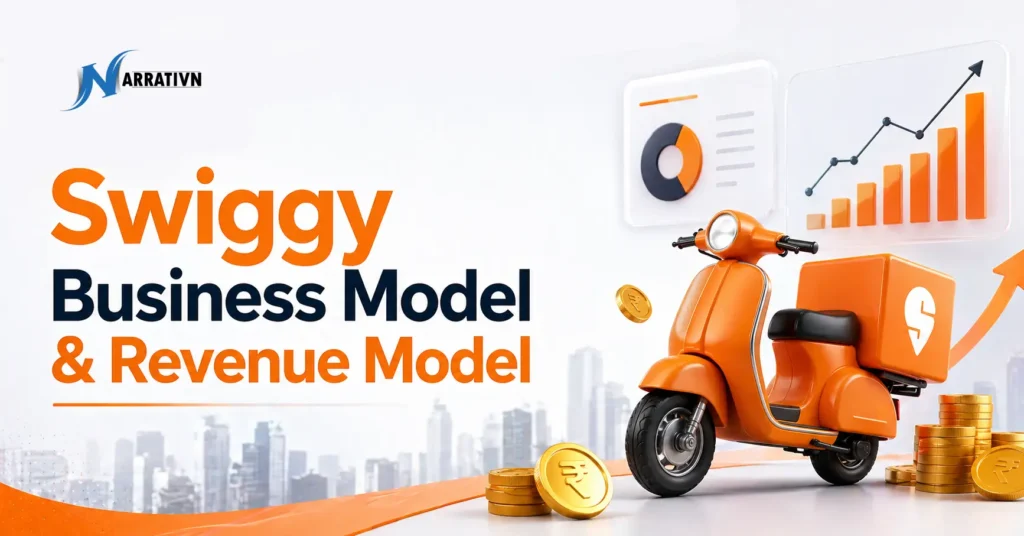
Swiggy operates as a multi-sided hyperlocal delivery platform — connecting customers, restaurants, and delivery partners through a single app. It earns revenue through restaurant commissions (15%–30% per order), delivery fees, in-app advertising, subscription memberships, and verticals including Instamart, Dineout, and Bolt. In FY25, Swiggy posted ₹15,227 crore in revenue — a 35% year-on-year increase.
From Bundl to Behemoth: The Origin Story Most People Get Wrong
Most people think Swiggy started as a food delivery idea. It didn’t.
In 2013, Sriharsha Majety and Nandan Reddy launched a company called Bundl Technologies — a logistics aggregator for e-commerce sellers. The goal was to simplify courier delivery across India. It failed. However, the experience gave both founders a deep understanding of one critical fact: India’s last-mile logistics infrastructure was fundamentally broken.
After shutting down Bundl, they identified a different gap. Zomato, at the time, was purely a restaurant discovery platform. It listed menus. It did not deliver food. That gap — between “I want to order food” and “someone actually brings it to my door” — was precisely what Swiggy was built to fill.
In August 2014, Majety and Reddy teamed up with Rahul Jaimini, a former Myntra engineer, and launched Swiggy in Koramangala, Bengaluru with 25 restaurant partners and 6 delivery executives. The first month produced just 35 orders.
What made Swiggy different from day one was its logistics-first approach. Unlike competitors who relied on restaurants to manage their own deliveries, Swiggy built and owned its entire delivery fleet. This was expensive. Investors in 2015 said asset-heavy models were bad. Swiggy ignored that advice — and that decision became the foundation of every competitive advantage it holds today.
Owning the full delivery experience meant owning the quality, the speed, and most importantly, the data. That data flywheel — built over hundreds of millions of orders across 10 years — is what makes the Swiggy business model structurally different from a simple marketplace.
What Type of Business Model Does Swiggy Follow?
Swiggy operates on what we’d describe as a full-stack hyperlocal aggregator model — not simply an aggregator, and not simply a logistics company, but a powerful combination of both.
The three-sided marketplace works like this:
Customers use the Swiggy app to browse nearby restaurants, place orders, and track deliveries live. They pay delivery fees and, optionally, subscribe to Swiggy One for free deliveries and exclusive benefits.
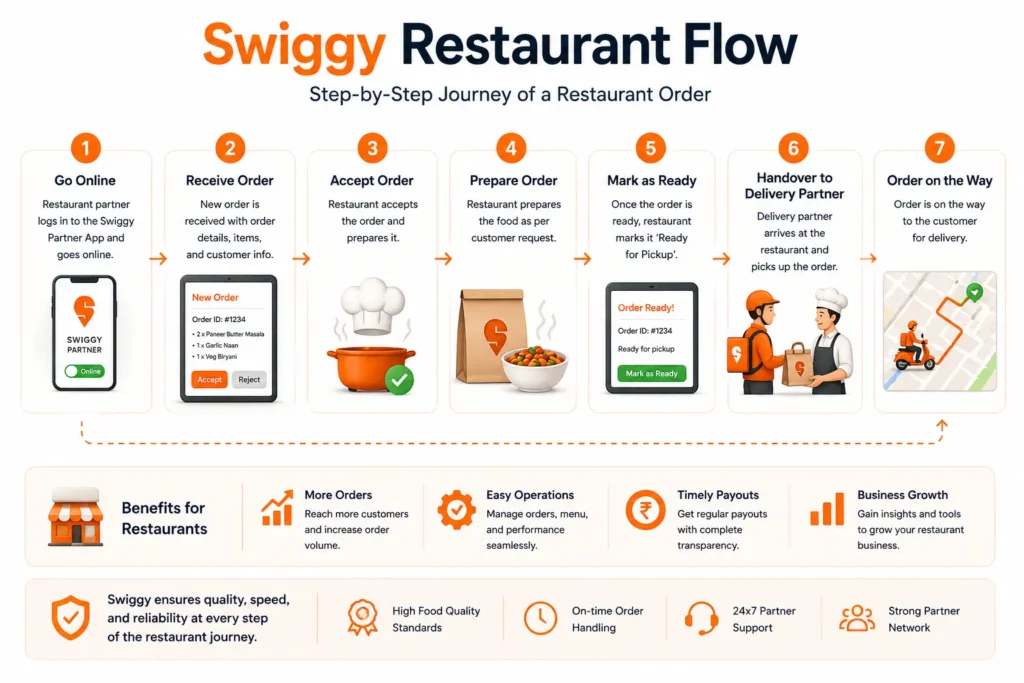
Restaurant Partners list their menus on the platform, receive orders, and pay a commission on every fulfilled order. In exchange, they access millions of active users, advertising tools, and Swiggy’s logistics network.
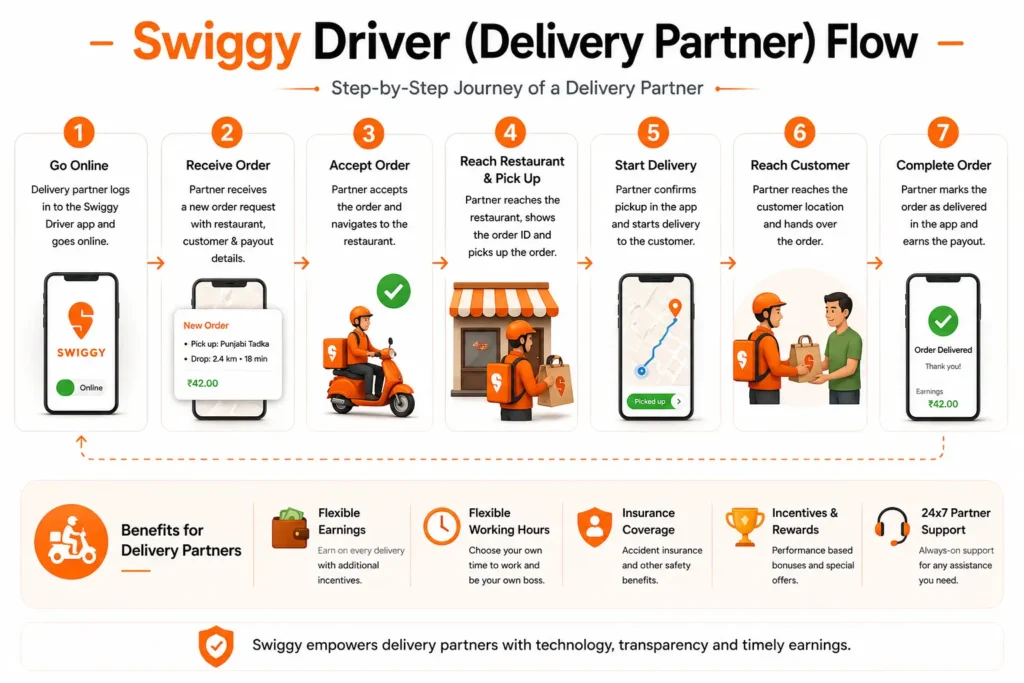
Delivery Partners are independent contractors who accept delivery assignments through the Swiggy rider app, earn per-order fees, and receive performance-based incentives.
Swiggy sits at the centre of all three groups. It provides the technology, the logistics intelligence, the payment infrastructure, and the trust layer that makes every transaction work. That central position is also what allows Swiggy to scale into new verticals — Instamart, Dineout, Bolt — without building an entirely new business each time.
Crucially, the same delivery fleet that drops off dinner at 8 PM can deliver milk from Instamart at 8 AM and pick up a document for Genie at 4 PM. This multi-vertical rider utilisation is one of the most powerful unit economics levers in Swiggy’s business model — and it is something pure-play competitors like Zepto structurally cannot replicate.
How Does Swiggy Make Money? All Revenue Streams Explained
Swiggy’s revenue model runs across seven distinct streams. Each one reinforces the others — and that interconnection is precisely what makes this business defensible at scale.
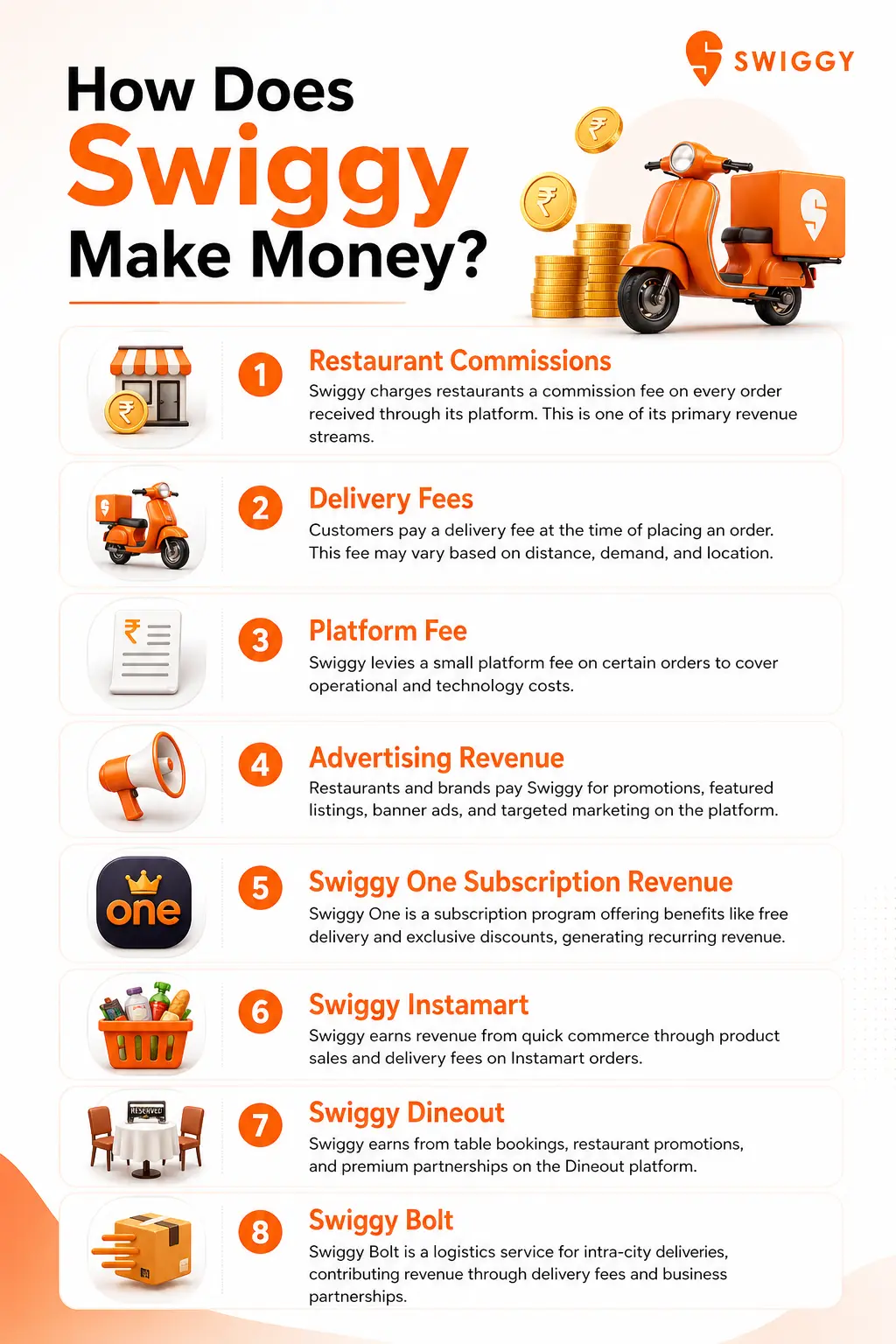
1. Restaurant Commissions — The Primary Revenue Engine (~45% of Revenue)
Every time a customer orders through Swiggy, the restaurant partner pays a commission. This fee typically ranges from 15% to 30% of the order value, depending on factors like city, restaurant size, order volume, and whether the restaurant uses Swiggy’s fleet or its own.
Restaurants wanting higher visibility — Swiggy Exclusive tags, “Top Picks” placement — pay at the upper end of this range. Newer restaurants and those in Tier-2 cities often pay closer to 15%.
This commission model is Swiggy’s most established revenue source. As food delivery GOV grows — it reached ₹34,068 crore in FY25 — even small improvements in commission take-rate add hundreds of crores of revenue. Food delivery take-rate reached 25.4% in Q4 FY25, a meaningful improvement from prior periods.
2. Delivery Fees and Platform Fee
Customers pay a variable delivery fee on every order. The fee depends on order value, distance, time of day, and demand conditions. During peak hours, rain, or midnight slots, surge pricing applies.
On top of the delivery fee, Swiggy charges a flat platform fee on every order — ranging from ₹6 to ₹14 depending on location. Across Swiggy’s 1.2 billion orders in FY25, this small per-order addition generates hundreds of crores in near-zero-cost revenue. (Source: Swiggy Q4 FY25 Filings, 2025)
As of late 2025, Swiggy had increased its platform fee to ₹14 in select locations — bringing it on par with Zomato’s charge.
3. Advertising Revenue — The Fastest-Growing Stream (~10% of Revenue)
Swiggy has built a retail media platform inside its app. Restaurants and FMCG brands pay for sponsored search placements, featured category positions, homepage banner ads, and priority listings.
This is the in-app equivalent of a supermarket shelf-end display. A restaurant that ranks at position 8 in search results pays to appear in position 1. For quick-service restaurants and cloud kitchens competing for digital visibility, this advertising spend is not optional — it is essential.
By 2025, Swiggy Ads reached an annualised run rate of ₹1,200 crore. (Source: BusinessModelCanvasTemplate.com / Swiggy Investor Data, 2025) That represents about 3% to 3.5% of GMV — a figure management plans to grow as order volume scales.
The advertising model compounds with scale. More orders generate more purchase intent data. More data enables better ad targeting. Better targeting justifies higher spend from brands. This loop mirrors how Amazon’s advertising business grew to become its most profitable segment.
4. Swiggy One Subscription Revenue
Swiggy One is the company’s all-in-one paid membership programme. Subscribers get free deliveries on food and Instamart grocery orders above a threshold, exclusive dining deals through Dineout, early access to sales, and reduced surge fees.
The membership base crossed 5.7 million members in 2025. (Source: Swiggy Investor Disclosures / icoderzsolutions.com, 2025)
For Swiggy, a Swiggy One member is the highest-lifetime-value customer on the platform. They order more frequently — because the marginal delivery feels free. They use multiple verticals within the same session. And they are far less likely to switch to Zomato or Blinkit because the subscription creates genuine switching costs.
As Majety has noted publicly: “If I have free delivery on food AND groceries, I am mathematically incentivised to never open another app.” That is the flywheel Swiggy One is designed to build — and it is working.
5. Swiggy Instamart — Quick Commerce Revenue
Swiggy launched Instamart in August 2020 as a pandemic-era experiment in Bengaluru. It has since become the company’s most important growth asset.
Instamart is Swiggy’s quick commerce arm — delivering groceries, daily essentials, and a growing catalogue of non-grocery products through 1,136 dark stores across 131 cities as of Q3 FY26. (Source: Swiggy Q3 FY26 Earnings, January 2026) In FY25, Instamart’s GOV climbed 82% to ₹14,683 crore and adjusted revenue more than doubled to ₹3,811 crore. (Source: YourStory / Swiggy Annual Report FY25, July 2025)
Instamart earns through merchant commissions, customer delivery fees, and advertising revenue from FMCG brands. Swiggy’s management expects advertising to reach 6–7% of Instamart’s GMV over the long term — which, at current scale, would represent over ₹2,000 crore in annual high-margin advertising income.
We’ve already covered the complete Swiggy Instamart business model in a dedicated piece. The key point here is that Instamart does something for Swiggy’s unit economics that food delivery alone cannot: it gives the delivery fleet more orders per hour across more of the day.
6. Swiggy Dineout — Dining Revenue
Swiggy acquired Dineout in 2022 — at the time, India’s largest restaurant discovery and table-reservation platform. Dineout lets users book restaurant tables, pay bills through the app, and access exclusive dining deals.
Dineout earns by charging restaurants a commission on every table booking and bill payment. It also earns through its Gourmet Passport subscription, which offers users flat discounts at premium restaurants.
Dineout reported its first profitable quarter in Q4 FY25 — a meaningful milestone that shows Swiggy’s non-food verticals can reach self-sustaining economics. (Source: Swiggy Q4 FY25 Filings, 2025) Furthermore, Dineout gives Swiggy a full-lifecycle relationship with the dining customer — from ordering food at home to dining out at a restaurant — which no other platform in India offers end-to-end.
7. Swiggy Bolt — 10-Minute Food Delivery
Bolt is Swiggy’s newest and most strategically significant product bet — and it is the one that most clearly signals where the food delivery market is heading.
Launched in October 2024, Bolt promises 10-minute food delivery from restaurant partners within 2 km of the customer. The service focuses on ready-to-pack items — biryani, beverages, ice cream, burgers — that require no kitchen preparation time. By May 2025, Bolt was live in over 500 cities. By Q4 FY25, it contributed 12% of Swiggy’s total food delivery volume. (Source: Outlook Business / Swiggy Q4 FY25 Earnings Call, May 2025)
The contrast with Zomato is stark. Zomato launched a competing service called Zomato Quick — which reached 8% of order volume before being shut down in early 2025, with management citing no clear path to profitability. Swiggy, by contrast, doubled down. Rohit Kapoor, CEO of Swiggy’s Food Marketplace, stated clearly: “Each order is profitable for sure.” (Source: Outlook Business, May 2025)
Additionally, users acquired through Bolt show 4–6% higher monthly retention than the platform average. (Source: Business Standard / Swiggy Investor Call, May 2025) This makes Bolt a customer acquisition engine, not just a delivery format.
How Does Swiggy Business Model Work? The Full Order Flow
Understanding how the Swiggy business model works in practice requires following a single order through the system.
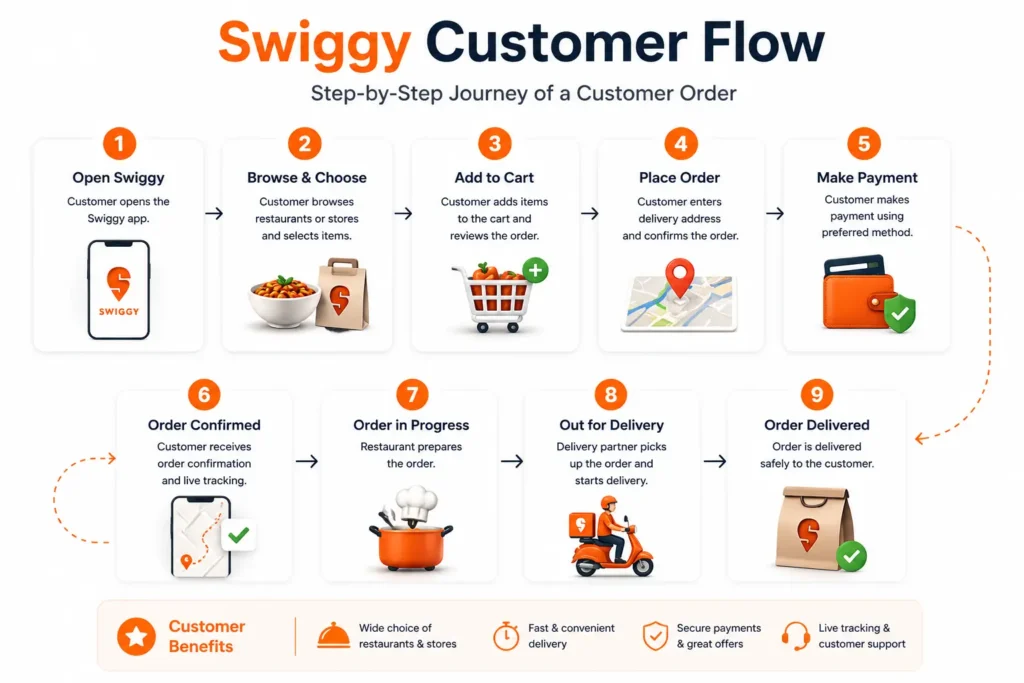
First, a customer opens the app and browses nearby restaurants — ranked by delivery time, rating, and personalised relevance to their location and order history.
Next, the customer places an order and pays through UPI, card, Swiggy wallet, or cash on delivery. The restaurant receives an instant notification and begins preparation.
Simultaneously, Swiggy’s routing algorithm assigns the nearest available delivery partner — factoring in proximity, current workload, and live traffic. The rider departs toward the restaurant as the food is being packed.
After pickup, the customer tracks the delivery in real time. After completion, Swiggy settles its three-way accounts: it collects the full order value from the customer, pays the restaurant after deducting commission, and pays the delivery partner their per-order fee.
This process sounds simple. The technology beneath it is not. Swiggy’s platform handled 1.2 billion orders in FY25 and supports peak loads of roughly 25,000 orders per minute during high-demand periods.
That processing capacity, built over 10 years of operations, cannot be replicated overnight by any new entrant.
Swiggy Customer Flow
Swiggy Restaurant Flow
Swiggy Driver (Delivery Partner) Flow
What Is the Dark Store Model Behind Instamart?
The dark store model is the engine behind Instamart — and understanding it reveals why Swiggy’s quick commerce economics are improving so rapidly.
A dark store is a micro-warehouse, typically 1,500 to 10,000 square feet, placed inside dense urban neighbourhoods. These stores are closed to walk-in customers. They exist solely to fulfil online orders. Pickers receive order lists on devices, assemble items in 2–3 minutes, and riders deliver them within 10–20 minutes total.
Swiggy’s key differentiator is its megapod format — large-format dark stores of 8,000 to 10,000 square feet that stock up to 40,000 SKUs. Standard dark stores typically hold 2,000 to 3,000 items. Megapods stock bedsheets in 15 colours, six protein powder brands, multiple face wash variants, and the same staple groceries — all in one location.
This matters greatly for economics. A ₹200 impulse order is difficult to fulfil profitably. A ₹746 planned stock-up order from a megapod — Instamart’s average order value as of Q3 FY26 — works very well on the same delivery infrastructure. As a result, Instamart’s average order value briefly overtook Blinkit’s in Q2 FY26, at ₹697 vs ₹693. (Source: Swiggy Q2 FY26 Shareholder Letter, October 2025)
Case Study: How Swiggy’s Multi-Vertical Rider Model Beats Single-Category Competitors
Here is the most underappreciated structural advantage in the Swiggy business model — one that most analysis of Indian food-tech completely misses.
A delivery rider at Zepto — a pure-play grocery platform — works during hours when grocery demand peaks: morning and evening. During lunch and dinner hours, when food delivery demand is highest, that rider is largely idle.
A Swiggy rider’s day looks completely different. At 8 AM, they deliver milk from Instamart. At 1 PM, they deliver office lunch orders from the food delivery platform. At 4 PM, they carry a document pickup from Genie. At 8 PM, they deliver dinner. The same rider, the same fixed cost, generates revenue across four separate verticals throughout the day.
This cross-vertical rider amortisation directly reduces Swiggy’s cost per delivery — which is the single most important variable in the unit economics of any delivery business.
The results are showing up in the financials. Swiggy’s adjusted EBITDA loss narrowed to ₹695 crore in Q2 FY26, down significantly from ₹813 crore in Q1 FY26. (Source: Swiggy Q2-FY26 Shareholder Letter, October 2025) That improvement was driven partly by better rider utilisation per order, not just revenue growth.
For any entrepreneur studying the delivery economy, this case makes a core principle visible: the platform that makes its fixed costs work across multiple revenue streams wins on unit economics — regardless of how strong the competition is in any single category.
Swiggy’s Financial Performance: What the Numbers Say
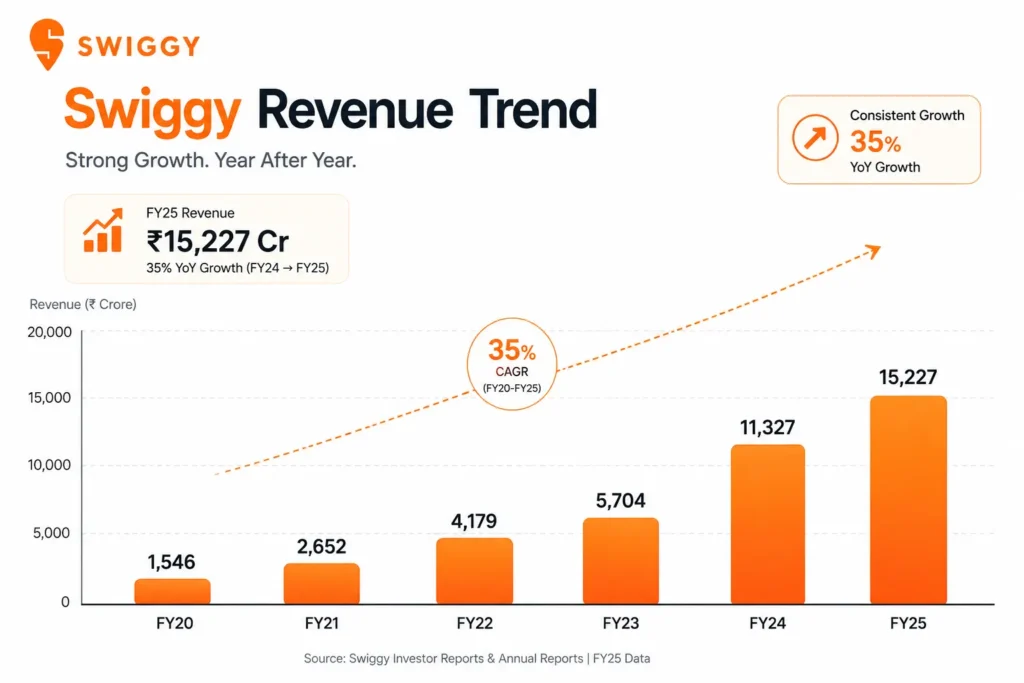
The scale of Swiggy’s growth in FY25 is exceptional by any serious measure.
According to Swiggy’s FY25 audited results:
- Revenue from Operations: ₹15,227 crore — up 35% from ₹11,247 crore in FY24. (Source: Indian Retailer / Swiggy Q4 FY25 Results, May 2025)
- Adjusted Revenue: ₹9,028 crore — up 46% year-on-year.
- Instamart GOV: ₹14,683 crore — up 82% year-on-year.
- Instamart Adjusted Revenue: ₹3,811 crore — more than doubled year-on-year. (Source: YourStory / Swiggy Annual Report FY25, 2025)
- Food Delivery GOV Growth: 18% year-on-year.
- Net Loss: ₹3,117 crore in FY25 — primarily from Instamart dark store expansion.
- Adjusted EBITDA Loss: Narrowed 30% to ₹1,911 crore in FY25 — a major improvement.
- Monthly Transacting Users: 19.8 million average — up 34.5% year-on-year.
These numbers tell the story of a business that is deliberately trading near-term losses for structural market share in India’s quick commerce space — a market CareEdge Ratings projects will reach ₹2 lakh crore by FY28.
Swiggy listed on Indian exchanges in November 2024 at ₹420 per share, raising approximately ₹4,200 crore in net IPO proceeds. In December 2025, it raised a further ₹10,000 crore through a QIP — earmarking ₹4,475 crore specifically for Instamart’s dark store and infrastructure expansion.
Is Swiggy Profitable? An Honest Assessment
Not yet at the consolidated EBITDA level. However, the segment-by-segment picture is more nuanced — and more encouraging — than the headline loss figure suggests.
Swiggy’s food delivery business is contribution-margin profitable. Take-rate improvements and the platform fee pushed food delivery’s contribution margin to 7.8% in Q4 FY25. Adjusted EBITDA margin for food delivery reached 2.9% of adjusted revenue. (Source: HDFC Securities Research on Swiggy, May 2025)
Dineout turned profitable in Q4 FY25. Bolt is profitable per order, per Swiggy’s own disclosures.
Instamart remains loss-making overall — posting an adjusted EBITDA loss of ₹908 crore in Q3 FY26. That said, contribution margins improved by over 200 basis points each in Q2 and Q3 FY26. One in four Instamart dark stores was profitable on a store-level basis by Q2 FY26. (Source: Swiggy Q2 FY26 Shareholder Letter, October 2025)
Swiggy’s management has targeted Instamart contribution breakeven between late 2025 and mid-2026. The path there runs through continued AOV growth, non-grocery category adoption, and advertising revenue scaling with order density.
Swiggy vs. Zomato: How the Business Models Differ
India’s two dominant food-tech platforms have taken notably different strategic paths — especially in quick commerce and 10-minute delivery.
| Factor | Swiggy | Zomato (Eternal) |
| Quick Commerce | Instamart — 1,136 dark stores, 131 cities | Blinkit — 1,816 dark stores, inventory-owned |
| 10-Min Food Delivery | Bolt — 12% of food orders, profitable, 500+ cities | Zomato Quick — shut down May 2025 |
| Inventory Model | Instamart marketplace-led (transition planned) | Blinkit fully inventory-owned since Sept 2025 |
| Dining Vertical | Dineout — profitable Q4 FY25 | Not a core vertical |
| Subscription | Swiggy One — 5.7M members | Zomato Gold |
| FY25 Adjusted Revenue | ₹9,028 crore | Higher (Blinkit’s contribution is substantial) |
The most strategically important difference today: Blinkit already made the shift to a fully inventory-owned model in September 2025 — giving it full pricing control and better margin capture. Swiggy Instamart is still primarily a marketplace, though management has confirmed the transition is “an eventuality.” When it happens, Swiggy expects a 50–70 basis point improvement in quick commerce economics, per CFO Rahul Bothra’s guidance.
For a deeper comparison of all three platforms in the quick commerce space, we’ve covered the Blinkit business model and the Zepto business model in separate deep-dives.
How Does Swiggy Use Technology to Run Its Business?
Technology is not a feature of Swiggy’s business model. It is the business model.
Swiggy’s proprietary platform supports 25,000 orders per minute at peak and processed 1.2 billion orders in FY25. (Source: BusinessModelCanvasTemplate.com / Swiggy Tech Infrastructure Data, 2025) Several tech systems make this possible at scale.
Demand Forecasting: Swiggy’s AI models predict order volumes by location, time, weather, and local events. This determines how many riders Swiggy deploys in each zone at each hour — directly reducing wait times and idle rider cost.
Dynamic Routing: Every delivery assignment uses real-time traffic data, rider location, and order prep times to minimise total delivery time. This is what makes Bolt’s 10-minute promise operationally realistic at scale.
Hyper-Personalisation: Swiggy uses order history and time-of-day patterns to serve each user a personalised home screen. A user who orders biryani every Friday evening sees biryani featured prominently at that time. This increases both conversion rates and average order value simultaneously.
Advertising Intelligence: Swiggy Ads uses the same purchase intent data to help restaurant and FMCG partners target specific user segments. The result is a high-margin, data-driven advertising business sitting inside a transactional platform — exactly the model Amazon proved at global scale.
In total, Swiggy’s data assets — over 300 million annual orders feeding granular behavioural models — are arguably its deepest competitive moat. This data took 10 years and hundreds of crores of operating losses to build. No new entrant can purchase it.
What Are Swiggy’s Key Growth Strategies for the Future?
Swiggy has clearly signalled three growth vectors for FY26 and beyond.
Bolt Expansion: Swiggy is doubling down on 10-minute food delivery while Zomato has exited the space. With Bolt contributing 12% of food delivery volume — and each order profitable — the medium-term plan is to increase Bolt’s share while gradually expanding the restaurant partner base beyond ready-to-pack items. Swiggy’s food marketplace CEO Rohit Kapoor has confirmed Bolt generates “4–6% higher monthly retention” for newly acquired users. (Source: Business Standard, May 2025)
Instamart Inventory Transition: When Instamart makes the shift from marketplace to inventory-owned model, it will unlock full pricing control, better promotional leverage with FMCG brands, and structurally better margins. Swiggy’s own estimates suggest a 50–70 basis point improvement in quick commerce economics at that point.
Tier-2 and Tier-3 City Penetration: India’s food services market is projected to cross USD 120–125 billion by 2030, per Swiggy’s own research with Kearney. By March 2025, Instamart was already present in 131 cities including 32 new markets. The megapod format — with its large SKU variety and the MaxxSaver bundling model — is well-adapted to smaller city economics in a way the original impulse-buy dark store model never was.
FAQ
What type of business model does Swiggy follow?
Swiggy follows a multi-sided hyperlocal aggregator model. It connects customers, restaurant partners, and delivery executives on a single platform. It earns money through commissions, delivery fees, advertising, subscriptions, and verticals like Instamart and Dineout. Some analysts also classify it as a “full-stack logistics platform” because Swiggy manages its own delivery fleet rather than relying on restaurants for delivery.
How does Swiggy make money?
Swiggy earns through seven streams: restaurant commissions (15%–30% per order), customer delivery and platform fees, in-app advertising (₹1,200 crore annualised in 2025), Swiggy One subscription revenue, Instamart quick commerce revenue, Dineout table booking commissions, and Bolt 10-minute food delivery. Restaurant commissions remain the largest single contributor at roughly 45% of total revenue.
What is Swiggy’s revenue for FY25?
Swiggy’s revenue from operations for FY25 was ₹15,227 crore — a 35% increase from ₹11,247 crore in FY24. Its adjusted revenue grew 46% to ₹9,028 crore. Instamart’s adjusted revenue more than doubled to ₹3,811 crore in the same period.
Is Swiggy profitable in 2025?
Swiggy’s food delivery and Dineout verticals are profitable at the contribution margin level. Bolt is profitable per order. However, Instamart remains loss-making overall due to heavy dark store expansion spending. Swiggy’s consolidated adjusted EBITDA loss narrowed 30% to ₹1,911 crore in FY25. Full EBITDA profitability depends on Instamart reaching contribution breakeven, which management has targeted for mid-2026.
What is Swiggy One and how does it affect the business model?
Swiggy One is Swiggy’s paid membership programme. Members get free deliveries on food and grocery orders, exclusive dining deals through Dineout, and reduced surge fees. The base crossed 5.7 million in 2025. For Swiggy, One members order more frequently, use more verticals, and churn far less — making them the highest-lifetime-value customers on the platform.
What is Swiggy Bolt and how does it work?
Bolt is Swiggy’s 10-minute food delivery service, launched in October 2024 and now live in over 500 cities. It partners with restaurants offering ready-to-pack dishes — items requiring no kitchen preparation time — located within 2 km of the customer. Bolt accounts for 12% of Swiggy’s total food delivery volume and is profitable per order. Rival Zomato shut down its equivalent service in early 2025.
How is Swiggy different from Zomato’s business model?
Both platforms compete in food delivery, but Swiggy has a broader multi-vertical structure. Swiggy owns Instamart and Dineout, while Zomato/Eternal owns Blinkit. Blinkit transitioned to a fully inventory-owned model ahead of Instamart. Swiggy doubled down on 10-minute food delivery through Bolt while Zomato exited that segment. Swiggy also benefits from cross-vertical rider utilisation — the same delivery fleet serves food, grocery, and dining orders — which pure food delivery models cannot replicate.
What are the biggest risks to Swiggy’s business model?
The most significant risks include Instamart’s continued cash burn delaying overall profitability, intense competition from Blinkit in quick commerce, the potential impact of ONDC reducing commission rates, regulatory uncertainty around gig worker classification in India, and rising customer acquisition costs in markets where Zomato and Blinkit already have strong user bases.